








Arthrosamid
Hydrogel→Joint lining→Symptom management
A polyacrylamide hydrogel that integrates with the joint lining. Intended for knee osteoarthritis symptom management.
 Reviewed byProfessor Paul YF Lee MBBch, FRCS (Tr & Orth), PhDCartilage and joint preservation expertise
An injection and an operation answer different needs. Explore symptom management, joint replacement and how the decision is made.
A polyacrylamide hydrogel that integrates with the joint lining. Intended for knee osteoarthritis symptom management.
Partial or total knee replacement replaces worn joint surfaces with implants. It involves surgical planning and rehabilitation.
Knee replacement removes and replaces the joint surface — it is a major operation for end-stage arthritis with a strong evidence base. Arthrosamid® is a non-surgical injectable hydrogel that treats symptoms through the joint lining without altering the underlying joint. Where the joint and clinical picture make a non-surgical option reasonable, Arthrosamid may be discussed for symptoms; where the disease is end-stage, replacement may be the more appropriate and predictable route.
HOW IT WORKS
LOOKING AHEAD
YOUR TREATMENT PLAN
CARE & PRECAUTIONS
These are very different procedures with very different risk profiles. Arthrosamid® is an outpatient injection; a serious potential risk is joint infection. Knee replacement is major surgery with the risks inherent in any joint replacement — infection, venous thromboembolism, anaesthetic complications, and a rehabilitation period of weeks to months.
Arthrosamid® at London Cartilage Clinic uses routine IV antibiotic cover and ultrasound guidance. Knee replacement is delivered through hospital admission with the standard peri-operative care that surgery requires. See Arthrosamid® infection risk and prevention for the injection-specific protocol.
YOUR KNEE, YOUR GOALS

Knee replacement is the right answer for end-stage osteoarthritis — bone-on-bone change, severe deformity, persistent symptoms despite conservative measures, and a clinical and imaging picture that supports it. We will say so honestly when this is the case.
Arthrosamid may be discussed for symptom management where a non-surgical option is reasonable, expectations are realistic and the safety protocol is acceptable. It is not proved to delay replacement and is not a substitute where surgery is clinically appropriate. See who is suitable for Arthrosamid?.
PLANNING THE COST
Published London Cartilage Clinic prices. The specialist consultation is £350 separately for each pathway.
OUTPATIENT INJECTION
One box. Two boxes £5,500; three boxes £8,000. Your clinical assessment confirms the requirement.
Full Arthrosamid pricing →TOTAL KNEE REPLACEMENT
Total knee replacement delivered using the clinic’s TWIS-TKR approach.
Full knee replacement pricing →PARTIAL KNEE REPLACEMENT
For selected knees where only one compartment needs replacing. The LCC price reflects custom planning and instrumentation.
What the surgical price includes →Arthrosamid: ultrasound, product, the injection protocol including IV antibiotics, and six-week follow-up.
Knee replacement: theatre, implant, surgeon and consultant anaesthetist fees, two post-operative consultations and a six-month review, with access to the surgical team for concerns.
The £350 pre-treatment consultation, any required imaging or pre-operative blood tests, onward physiotherapy, and travel or accommodation. Confirm your individual plan and inclusions before proceeding.
These treatments meet different clinical needs. Cost belongs in the discussion alongside suitability, expected benefit, risks and recovery.
LCC prices reviewed October 2026. Your consultation confirms the appropriate treatment and written care plan.
MAKING A RECOMMENDATION
CHOOSING ANOTHER PATH
Arthrosamid® and knee replacement sit at different points on the treatment ladder for knee osteoarthritis. Arthrosamid has not been proved to delay or prevent knee replacement, and it is not a substitute where replacement is clinically appropriate. Where non-surgical symptom management remains reasonable, Arthrosamid may be discussed. Where the disease is end-stage, replacement is usually the right answer. We will tell you honestly which one fits your case.
Arthrosamid® vs Knee Replacement
Arthrosamid has not been proved to delay or prevent knee replacement. It may be discussed as symptom management where non-surgical care remains reasonable, but it is not a substitute where replacement is clinically appropriate. The decision depends on symptoms, examination, imaging, function and goals.
No. The observational cohort reports group-level symptom outcomes through 24 months, but it has no randomised control group and was not designed to prove that replacement was delayed. Symptom change should not be converted into a surgery-delay claim.
Evidence is not sufficient to promise that a future operation will be unaffected. Tell any future surgeon about the product, injection date, response and any complication. A surgical team can then plan using the complete clinical record.
That needs individual assessment. Where non-surgical symptom management remains reasonable, Arthrosamid may be one option to discuss. Where the clinical and imaging picture supports replacement, an injection should not be presented as a substitute or a proved way to delay surgery.
No. Arthrosamid® is a non-absorbable hydrogel, not a regenerative treatment or cure. It does not regenerate cartilage or reverse the underlying arthritis. It manages symptoms while the underlying disease continues to be what it is. See the Arthrosamid® clinical evidence page.
Yes, knee replacement is a routine NHS procedure for clinically appropriate cases, though waiting times vary. Arthrosamid® is not routinely funded by the NHS. See the Arthrosamid® self-pay and payment page for the private-pay context.
Detailed information on suitability, research, and recovery to help you prepare for your consultation.
Could Arthrosamid be right for your knee? How the clinic approaches treatment recommendations.
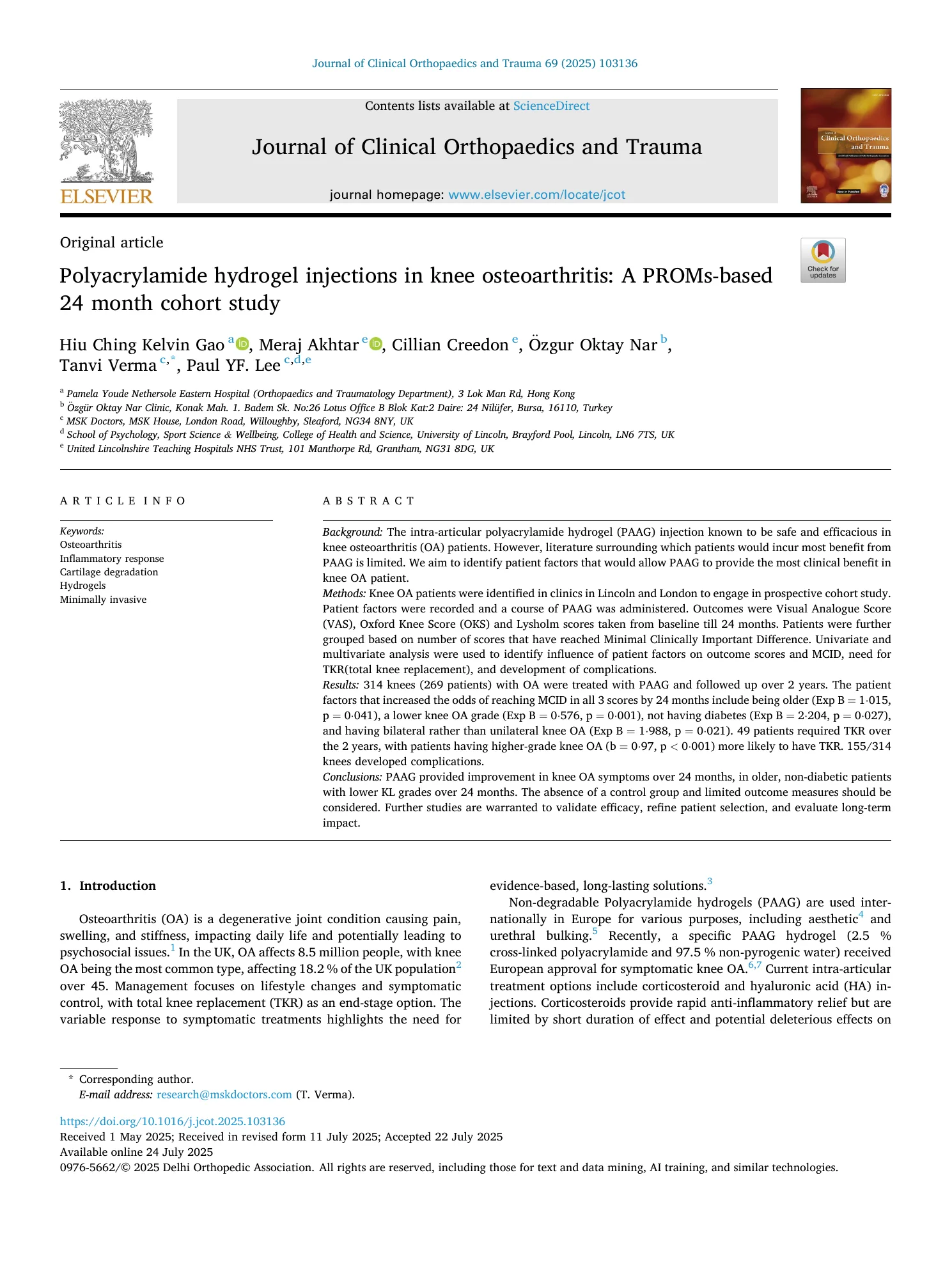
The research behind the treatment, including the 24-month prospective cohort study.

Your recovery, one step at a time. Milestones, activity guidelines, and when to seek advice.