








Arthrosamid
Hydrogel→Joint lining→Symptom management
A polyacrylamide hydrogel that integrates with the joint lining. Intended for knee osteoarthritis symptom management.
 Reviewed byProfessor Paul YF Lee MBBch, FRCS (Tr & Orth), PhDCartilage and joint preservation expertise
Compare short-term inflammation relief with a non-absorbable hydrogel approach, and what each involves in practice.
A polyacrylamide hydrogel that integrates with the joint lining. Intended for knee osteoarthritis symptom management.
A corticosteroid injection is used for short-term control of inflammation and symptoms. Timing and repeat treatment need clinical review.
The core difference is mechanism and intended role. Steroid injections work pharmacologically to reduce inflammation and are generally used for selected short-term aims. Arthrosamid® is a non-absorbable material intended for symptomatic adult knee osteoarthritis. Neither mechanism supplies an individual response or duration guarantee.
HOW IT WORKS
LOOKING AHEAD
YOUR TREATMENT PLAN
CARE & PRECAUTIONS
Both treatments are delivered under ultrasound guidance at London Cartilage Clinic. The most serious shared risk includes joint infection. Beyond infection, each treatment has its own risk profile. Ultrasound guidance and sterile technique do not eliminate risk.
Corticosteroid injections carry small risks of post-injection flare in the days after the injection, fat-pad atrophy at the injection site, transient blood-sugar rise (relevant for diabetic patients), and concerns about cumulative cartilage and tendon effects from repeated use in the same joint.
Arthrosamid® is non-absorbable and intended to remain in the joint, so a serious infection may be harder to manage than for steroid. This is why we use routine IV antibiotic cover for Arthrosamid® specifically. See Arthrosamid® infection risk and prevention and Arthrosamid® side effects and safety.
YOUR KNEE, YOUR GOALS

Steroid injections suit patients with short-term flares of knee osteoarthritis, those who need symptom relief ahead of a specific event (a planned holiday, a wedding, a return to activity), and those for whom a longer-acting injection is not appropriate.
Arthrosamid® may be discussed with patients who have established knee osteoarthritis and are willing to consider a non-absorbable single-injection option, while understanding it is not proved to delay surgery. Neither treatment is a substitute for knee replacement where replacement is clinically appropriate. See who is suitable for Arthrosamid?.
PLANNING THE COST
Published London Cartilage Clinic prices. Compare the recommended care plan as well as the price of one procedure.
HYDROGEL INJECTION
Two boxes £5,500; three boxes £8,000. Consultation £350 separately.
Full Arthrosamid pricing →SINGLE INJECTION / PROCEDURE
Includes clinic and doctor’s fees, ultrasound, consumables, equipment and one follow-up with the doctor.
LCC injection prices and inclusions →At London Cartilage Clinic, Arthrosamid® costs from £3,000 for one box , inclusive of ultrasound, the product, the fifteen-step injection protocol and the six-week follow-up, with the consultation (£350) charged separately. See the Arthrosamid® cost guide for full pricing.
Steroid injections generally have a lower price per dose. Compare the actual recommended treatment, inclusions, expected role and cumulative clinical concerns rather than assuming repeat timing or a particular Arthrosamid duration.
Confirm the number of procedures, any assessment fees and the complete written quote before deciding. A per-procedure price is not a promise about the number of treatments you will need.
Published LCC injection prices checked 29 October 2026. Your clinical assessment confirms the appropriate treatment and plan.
MAKING A RECOMMENDATION
CHOOSING ANOTHER PATH
Steroid injection and Arthrosamid® are tools for different jobs. Steroid is for selected short-term aims ; Arthrosamid® is a non-absorbable single-injection option. Where a patient is on a pattern of repeating steroid, the diagnosis, prior response, cumulative steroid concerns and Arthrosamid evidence limits all need review. Neither is automatically better. The choice is made at consultation with imaging review.
Arthrosamid® vs Steroid Injection
Not automatically. Arthrosamid has observational outcomes reported through 24 months; steroid has a different, often shorter-term role. Evidence, risks, previous response and the clinical aim decide which is appropriate. They are tools for different jobs.
Prior steroid is not automatically a contraindication, but the interval and suitability depend on the diagnosis, injection date, response, current symptoms and infection risk. Timing is agreed at consultation rather than using a universal rule.
There is no safe universal number for this page to prescribe. Frequency should be agreed with the treating clinician after considering the diagnosis, previous response, timing, diabetes and cumulative cartilage and tendon concerns.
The treatments have different risk profiles. Steroid carries corticosteroid-specific risks (post-injection flare, fat-pad atrophy, blood-sugar rise, cumulative concerns with repeated use). Arthrosamid® is non-absorbable and intended to remain in the joint, so infection management is more complex if it does occur — which is why we use routine IV antibiotic cover for Arthrosamid® specifically.
Steroid injections may be available through NHS pathways where clinically appropriate; local access varies. Arthrosamid® is not routinely funded by the NHS. See the Arthrosamid® self-pay and payment page for detail.
Detailed information on suitability, research, and recovery to help you prepare for your consultation.
Could Arthrosamid be right for your knee? How the clinic approaches treatment recommendations.
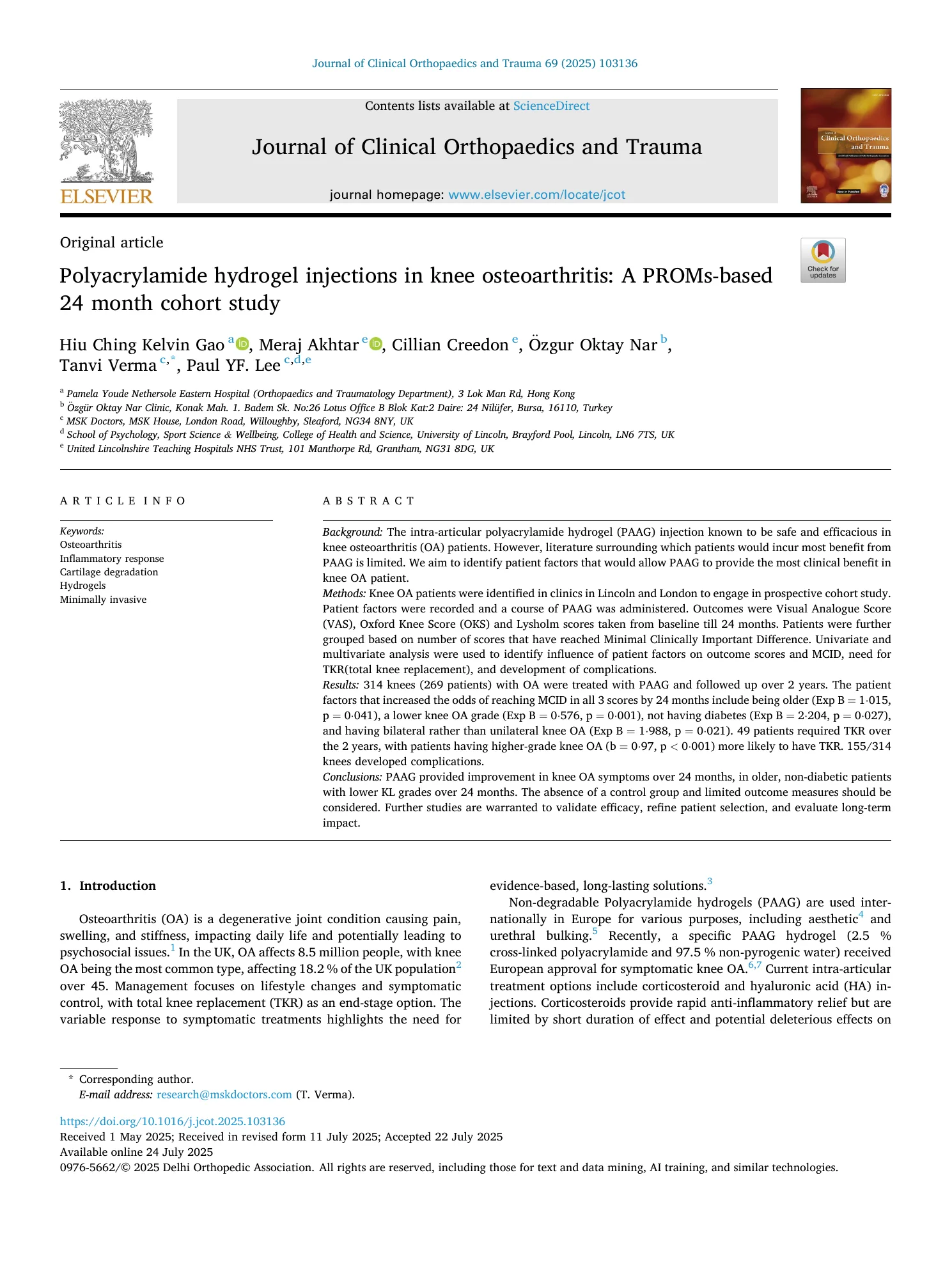
The research behind the treatment, including the 24-month prospective cohort study.

Your recovery, one step at a time. Milestones, activity guidelines, and when to seek advice.