Home Arthrosamid Arthrosamid vs PRP

Arthrosamid or PRP?

Two different approaches. A choice built around your knee and your treatment goals.

Transparent hydrogel / Supplied pre-filled

Source: arthrosamid.com

Arthrosamid

A manufactured, non-absorbable hydrogel injected into the knee, intended to integrate with the joint lining for knee osteoarthritis symptom management.

Simplified preparation illustration

Source: orthoinfo.org

PRP

Prepared from a sample of your own blood to concentrate platelets, which is then injected back into the knee.

01

HOW IT WORKS

Two approaches to the same problem

Arthrosamid

Arthrosamid® is a polyacrylamide hydrogel injected into the knee joint under ultrasound guidance. The gel integrates into the synovial membrane and is intended to remain in the joint. It is not regenerative.

Mechanism of action is through the synovium. The gel is incorporated into the membrane that lines the joint, and it is that membrane, settled and more supple, that accounts for the relief. It is not a biologic and it is not a lubricant.

PRP

PRP is prepared by taking a venous blood sample, processing it in a centrifuge to concentrate platelets and growth factors, then injecting the concentrate back into the joint, typically under ultrasound guidance.

The biological hypothesis is that concentrated platelets release growth factors that modulate the joint environment, reduce inflammation and may support cartilage health. Evidence quality in knee OA is variable.

02

LOOKING AHEAD

What can you expect over time?

Arthrosamid

24-month study follow-up
An observation period, not a duration guarantee

Observed to 24 months

The prospective observational cohort reports group-level outcomes through 24 months. With no randomised control group, so it describes the group; individual response and duration vary.

PRP

Months, typically
Preparation, response and the agreed course all matter

Months, typically

PRP duration in knee OA is typically several months to about a year, with substantial variability between patients and between PRP preparations. Whether and when to repeat treatment depends on the preparation, response and agreed plan.

PRP evidence in knee osteoarthritis is heterogeneous. Outcomes depend on preparation method, leukocyte content and patient selection. We will discuss what to expect for your specific case at consultation.

03

YOUR TREATMENT PLAN

What does the course involve?

Arthrosamid

Arthrosamid is commonly administered as a single injection treatment in selected patients. The clinical assessment confirms the product requirement for your knee.

PRP

PRP may be offered as a single injection or a series spaced over several weeks. The preparation, number of appointments and whether repeat treatment is appropriate depend on the proposed protocol and your response. Ask for the complete course and cost in writing.

The treatment journeys

Arthrosamid pathway

1

Clinical assessment

Review of symptoms, scans, previous care, and treatment goals to confirm suitability.

2

Hydrogel preparation

The manufactured, pre-filled polyacrylamide hydrogel is prepared for use by the clinician.

3

Ultrasound-guided injection

The hydrogel is injected into the joint space during a single outpatient appointment.

PRP pathway

1

Assessment & Blood sample

Following clinical assessment, a small sample of your own blood is drawn.

2

Processing

The blood is spun in a centrifuge to separate and concentrate the platelets.

3

Injection of PRP

The concentrated preparation is injected. This may be repeated depending on protocol.

04

CARE & PRECAUTIONS

Understanding the risks

BEFORE · DURING · AFTERPrecautions.
Clear advice.
Ongoing support.
Understand the pathway around the treatment.

Both treatments are delivered under ultrasound guidance at London Cartilage Clinic. The most serious risk for either includes joint infection. This page does not claim a comparative incidence without suitable head-to-head evidence. Sterile technique and image guidance do not eliminate risk.

Arthrosamid® uses a non-resorbable hydrogel, so a late infection is harder to manage than for resorbable injections. This is why we use routine IV antibiotic cover for Arthrosamid® specifically.

See Arthrosamid® infection risk and prevention and Arthrosamid® side effects and safety.

Practical planning and safety

Shared safety considerations

Both Arthrosamid and PRP involve an injection into the joint space. It is important to discuss temporary soreness or swelling, the risk of joint infection, and any considerations specific to your current health and prescribed medicines.

Read about Arthrosamid safety

Aftercare instructions

Personal clinical instructions take priority. Agree your intended return to daily activities, work and exercise before your treatment begins. Ask what follow-up is included and exactly who to contact if you have concerns.

Explore the Arthrosamid recovery timeline
05

YOUR KNEE, YOUR GOALS

Where does each option fit?

A consultation to discuss the right approach for your knee
Your symptoms, scans and goals guide the decision.

PRP is often considered for earlier-stage knee osteoarthritis where the goal is to modulate the joint environment alongside conservative care. Arthrosamid® tends to suit patients with established osteoarthritis who are willing to discuss a non-absorbable single-injection option. Arthrosamid is not proved to delay surgery.

Neither treatment regenerates cartilage. Neither is a substitute for knee replacement where replacement is clinically appropriate. See who is suitable for Arthrosamid? for the full framework.

What would make the difference for you?

Take these questions to your consultation to ensure the discussion focuses on your specific needs.

01

What is causing my knee pain?

Understanding the diagnosis helps frame which treatments are appropriate.

02

Why might this option suit my knee?

Ask the clinician to explain their recommendation based on your history.

03

What improvement are we aiming for?

Set realistic goals for pain reduction and function.

04

What happens if I need more help?

Discuss what future options remain open if symptoms return.

06

PLANNING THE COST

Compare the complete care package

Published London Cartilage Clinic prices. Compare the recommended care plan as well as the price of one procedure.

HYDROGEL INJECTION

Arthrosamid

From · one box£3,000

Two boxes £5,500; three boxes £8,000. Consultation £350 separately.

Full Arthrosamid pricing →

SINGLE INJECTION / PROCEDURE

PRP

LCC published price£1,200

Includes clinic and doctor’s fees, ultrasound, consumables, equipment and one follow-up with the doctor.

LCC injection prices and inclusions →

The Arthrosamid package

At London Cartilage Clinic, Arthrosamid® costs from £3,000 for one box , inclusive of ultrasound, the product, the fifteen-step injection protocol and the six-week follow-up, with the consultation (£350) charged separately. See the Arthrosamid® cost guide for full pricing.

Budget for the agreed plan

PRP pricing depends on the protocol (single injection vs course), processing system used, and whether ultrasound guidance is included. A full PRP course can cost a meaningful fraction of an Arthrosamid® injection. Compare the actual recommended PRP preparation and course rather than assuming either treatment's repeat schedule or duration.

Confirm the number of procedures, any assessment fees and the complete written quote before deciding. A per-procedure price is not a promise about the number of treatments you will need.

Published LCC injection prices checked 29 October 2026. Your clinical assessment confirms the appropriate treatment and plan.

07

MAKING A RECOMMENDATION

When each option may make sense

Arthrosamid

A discussion to have

You have established knee osteoarthritis with mild-to-moderate cartilage wear.

You want to discuss a non-absorbable single-injection option and a clear treatment plan.

You understand that symptom management is not proved to delay surgery and accept the product-specific safety protocol.

PRP

A discussion to have

You are at an earlier stage of knee osteoarthritis or have a sports-medicine type presentation where biologic modulation is the goal.

You prefer an autologous biologic and are willing to accept variable evidence quality and shorter duration.

You want to avoid a non-absorbable material intended to remain in the joint.

08

CHOOSING ANOTHER PATH

When another approach may be better

Arthrosamid

A reason to reconsider

End-stage bone-on-bone arthritis where Arthrosamid® is unlikely to deliver meaningful benefit.

Active infection or unwillingness to accept the conservative safety protocol.

Unrealistic expectation of cure, regeneration or guaranteed permanent relief.

PRP

A reason to reconsider

End-stage knee arthritis where PRP is unlikely to deliver meaningful benefit.

Patients whose priorities or previous response do not fit the proposed PRP course.

Where prior PRP has not delivered useful benefit, repeating may not be the right next step.

Common questions

Is one treatment always better?

There is no universal "best" treatment. The most suitable option depends on your specific knee, diagnosis, and treatment goals. Ask your clinician to explain the clinical reasoning behind their recommendation for your individual case.

Does PRP mean cartilage will grow back?

A blood-derived treatment is not a promise of cartilage regeneration. Discuss the intended symptom relief and functional goals for your treatment with your specialist.

Can I compare the full costs?

Yes. Always ask for a written quote covering the full proposed course of treatment, including the consultation, any necessary scans, follow-up appointments, and the treatment itself. Confirm current pricing directly with the clinic.

Is PRP better than Arthrosamid® for knee arthritis?

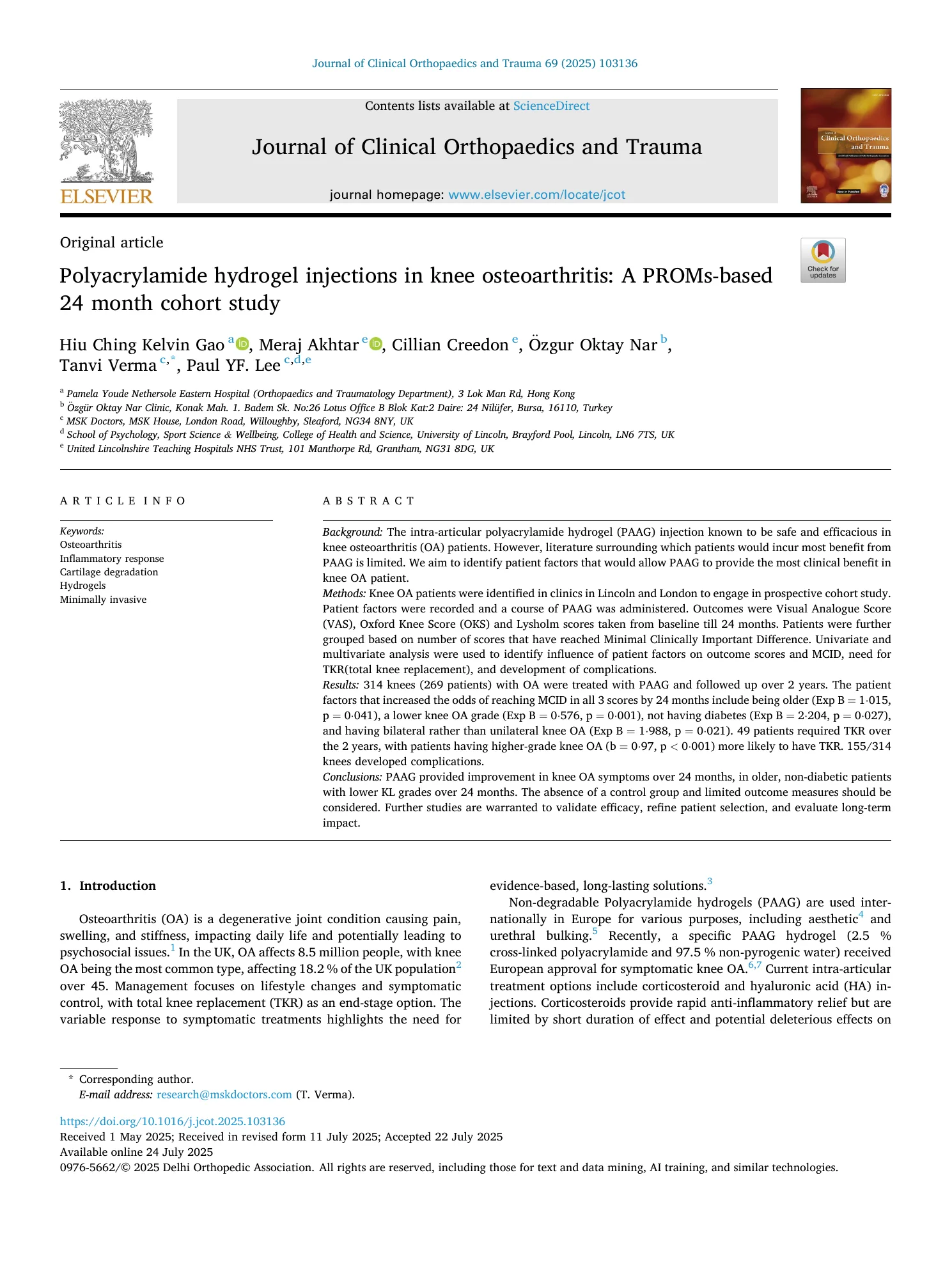
Not better or worse — different. PRP is a biologic intervention with months of duration and variable evidence in knee OA. Arthrosamid® is a non-resorbable hydrogel with observational group outcomes reported through 24 months. The right choice depends on diagnosis, evidence limits, patient goals and risk preferences.

Can I have Arthrosamid® after PRP?

Prior PRP is not automatically a contraindication, but it does not establish that Arthrosamid is suitable. We review the diagnosis, imaging, clinical picture, prior response and product-specific risks before recommending another injection.

Does the NHS offer PRP or Arthrosamid®?

Neither is routinely funded by the NHS for knee osteoarthritis. Both are accessed privately at London Cartilage Clinic. See the Arthrosamid® self-pay and payment page for detail.

How does PRP evidence compare to Arthrosamid® evidence?

PRP evidence in knee OA comes from randomised trials against saline and hyaluronic acid, with results that depend on the preparation used. Arthrosamid® evidence includes the 24-month prospective observational cohort. The two have different roles, so suitability decides rather than a blanket ranking. Read more on the Arthrosamid® clinical evidence page.

Can I have both PRP and Arthrosamid® in the same knee?

In principle yes, but rarely as a combined protocol. We typically choose the most appropriate single treatment based on the imaging, clinical picture and patient goals discussed at consultation.

Privacy & Cookies Policy
Free Discovery Call